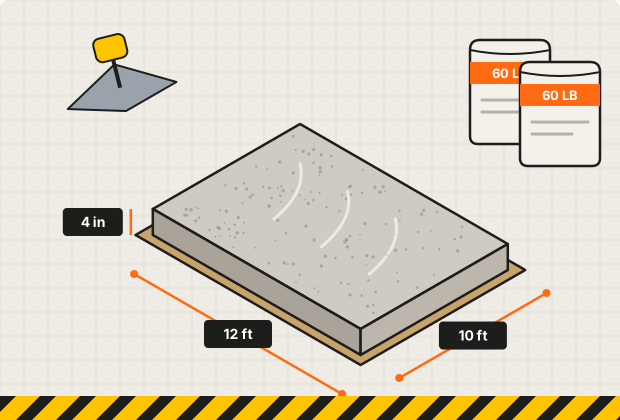
How to use this calculator
- Choose the shape: slab, footing, column or steps.
- Enter the length, width and depth (thickness) in the units shown.
- Set a waste allowance; 5–10% is typical.
- Read the volume in cubic yards and the number of 40, 50, 60 or 80 lb bags.
- Instant answersResults update as you type.
- Private by designRuns in your browser. Nothing is sent.
- Share, print or citeCopy a link with your numbers.
How it works
Volume (cu ft) = length × width × thickness ÷ 12. Divide by 27 for cubic yards, or by the bag yield for bags. Add 5–10% for uneven subgrade and spillage.
Assumes standard concrete mix bag yields: 80 lb ≈ 0.60 cu ft, 60 lb ≈ 0.45 cu ft. Check the yield on your bag. 1 cubic yard = 27 cubic feet.
Common slab sizes
- 4×4 slab0.20 yd³ at 4″
- 4×6 slab0.30 yd³ at 4″
- 4×8 slab0.40 yd³ at 4″
- 5×5 slab0.31 yd³ at 4″
- 6×6 slab0.44 yd³ at 4″
- 6×8 slab0.59 yd³ at 4″
- 8×8 slab0.79 yd³ at 4″
- 8×10 slab0.99 yd³ at 4″
- 10×10 slab1.23 yd³ at 4″
- 10×12 slab1.48 yd³ at 4″
- 10×16 slab1.98 yd³ at 4″
- 10×20 slab2.47 yd³ at 4″
- 12×12 slab1.78 yd³ at 4″
- 12×16 slab2.37 yd³ at 4″
- 12×20 slab2.96 yd³ at 4″
- 12×24 slab3.56 yd³ at 4″
- 14×14 slab2.42 yd³ at 4″
- 16×16 slab3.16 yd³ at 4″
- 16×20 slab3.95 yd³ at 4″
- 18×18 slab4.00 yd³ at 4″
- 20×20 slab4.94 yd³ at 4″
- 20×24 slab5.93 yd³ at 4″
- 20×30 slab7.41 yd³ at 4″
- 24×24 slab7.11 yd³ at 4″
- 24×30 slab8.89 yd³ at 4″
- 30×30 slab11.11 yd³ at 4″
- 30×40 slab14.81 yd³ at 4″
Bags per cubic yard
Bags of standard concrete mix for a given volume, before any waste allowance, using the yields printed on standard bags: 80 lb ≈ 0.60 cu ft, 60 lb ≈ 0.45 cu ft, 50 lb ≈ 0.375 cu ft, 40 lb ≈ 0.30 cu ft. Counts are rounded up to whole bags. Check the yield on the bag you buy, because some mixes differ.
| Volume | 80 lb bags | 60 lb bags | 50 lb bags | 40 lb bags |
|---|---|---|---|---|
| 0.5 yd³ (13.5 cu ft) | 23 | 30 | 36 | 45 |
| 1 yd³ (27 cu ft) | 45 | 60 | 72 | 90 |
| 1.5 yd³ (40.5 cu ft) | 68 | 90 | 108 | 135 |
| 2 yd³ (54 cu ft) | 90 | 120 | 144 | 180 |
| 3 yd³ (81 cu ft) | 135 | 180 | 216 | 270 |
Example slab volumes
Worked examples: volume = length × width × thickness (in feet) ÷ 27 for cubic yards. The last column adds a 10% waste allowance and divides by 0.60 cu ft per 80 lb bag.
| Slab | Cubic feet | Cubic yards | 80 lb bags with 10% waste |
|---|---|---|---|
| 10 × 10 ft, 4 in | 33.3 | 1.23 | 62 |
| 10 × 10 ft, 6 in | 50.0 | 1.85 | 92 |
| 12 × 12 ft, 4 in | 48.0 | 1.78 | 88 |
| 20 × 20 ft, 4 in | 133.3 | 4.94 | 245 |
| 4 × 4 ft, 4 in | 5.3 | 0.20 | 10 |
Bags or a ready-mix truck?
One cubic yard of bagged mix is 45 bags of 80 lb, about 3,600 lb to carry and mix by hand. Above roughly a cubic yard, or for any pour that has to be placed in one go, get a ready-mix quote and compare it with the bag price; many suppliers charge a short-load fee for small orders, so ask about it.
Frequently asked questions
How many 80 lb bags make a yard?
About 45 (27 ÷ 0.60).
When should I order ready-mix?
Many contractors switch from bags to a truck at around 1 cubic yard or more; check minimum-order fees locally.
How many 80 lb bags of concrete make a cubic yard?
45 bags. An 80 lb bag yields about 0.60 cubic feet and a cubic yard is 27 cubic feet, so 27 ÷ 0.60 = 45.
How much concrete do I need for a 10 × 10 slab 4 inches thick?
10 × 10 × 0.333 ft = 33.3 cubic feet, or 1.23 cubic yards. With a 10% waste allowance that is 62 bags of 80 lb mix.
How much extra concrete should I order?
Most estimates add 5–10% for uneven ground, form bulges and spillage. Running short in the middle of a pour is worse than one spare bag.
How many 60 lb bags of concrete make a cubic yard?
60 bags. A 60 lb bag yields about 0.45 cubic feet, and a cubic yard is 27 cubic feet, so 27 ÷ 0.45 = 60.
Should I buy 60 lb or 80 lb bags of concrete?
An 80 lb bag yields about 0.60 cubic feet against 0.45 for a 60 lb bag, so you need a quarter fewer bags, but each one is heavier to lift and mix. Compare the price per cubic foot rather than per bag.
How many cubic feet are in a cubic yard?
27, because a cubic yard is 3 ft × 3 ft × 3 ft. Divide cubic feet by 27 to get cubic yards, which is how ready-mix concrete is ordered.
How thick should a concrete slab be?
Four inches is the usual minimum for patios, walkways and shed floors. Driveways are often 4 to 6 inches, thicker where heavy vehicles park. Follow your local building code for anything structural.